

The State of AI Safety
Key insights from the latest AI Safety Index | Edition #305

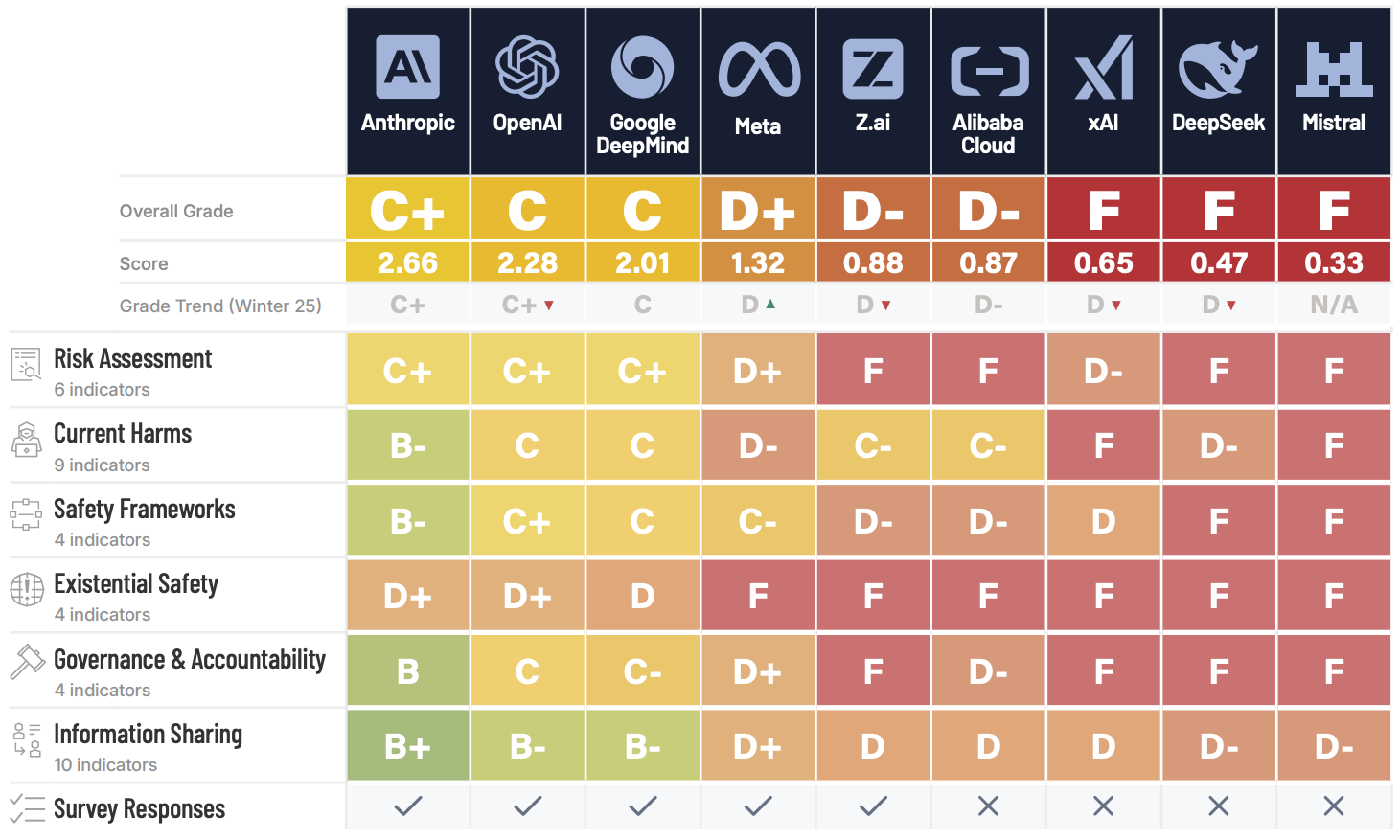
The Future of Life Institute's July 2026 AI Safety Index is out, offering an updated and detailed picture of the current state of AI safety.
An observation that stood out to me, also highlighted in the UN scientific panel's report I wrote about this week, is the mismatch between the speed of AI capability advancements and the accompanying AI governance mechanisms.
AI development seems to have outgrown some of the benchmarks built to measure and assess AI capabilities and risks.
At the same time, there are growing examples of serious AI implications that deserve more attention, such as AI chatbot-related dependence, deskilling, and self-harm, as well as an increasing interweaving of AI companies and the military.
This latest AI Safety Index noted that companies have not kept pace and, in various aspects, are actually moving backward.
Below are its key findings:
1. Anthropic, OpenAI, and Google DeepMind stay on top, Meta improves, and xAI deteriorates.
2. European dissonance: Although the European Union is a leader in AI safety regulation, the top European AI company, Mistral, scored dead last on safety.
3. Inadequate safety is a global problem. Three companies receive failing grades, one each from the United States (xAI), China (DeepSeek), and Europe (Mistral).
4. Reviewers flagged the industry's pivot to military AI use as an emerging current harm risk.
5. Anthropic, OpenAI, Google DeepMind, and Meta have weakened or voided their pledges to pause unilaterally if redlines are approached, with some citing conditions contingent on competitors.
6. Existential Safety is the weakest domain industry-wide. No company received a grade higher than C-.
7. Safety rhetoric outpaces revealed behavior. Across Google DeepMind, OpenAI, and xAI, leadership’s reassuring public messaging diverges from commercial conduct and legislative stance, making stated commitments an unreliable proxy for actual safety practice.
8. Companies are publishing and updating safety frameworks, but these frameworks lack teeth.