


I would like to recommend this excellent new piece by Ella Genasci Smith, Victor Y. Wu, and Jennifer King on one of my favorite topics: agentic AI governance.
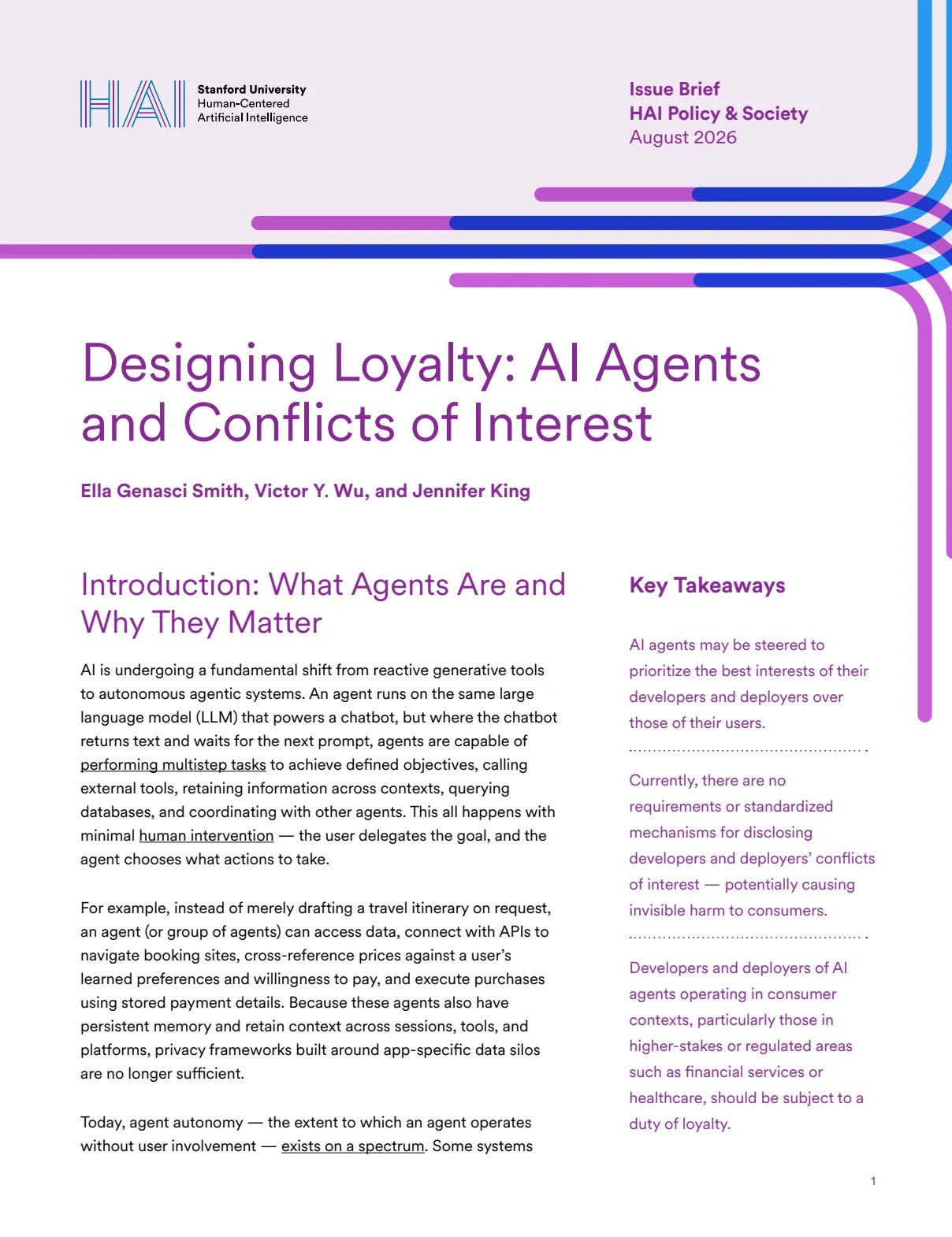
"Will an agent act in the user’s best interest when its developer’s interests diverge from theirs, and who is liable if the user suffers harm?"
As many have foreseen, the spread of non-human agency will lead to an overhaul of liability paradigms in various countries, as many legal systems do not yet address the new risks.
Also, as AI companies aim to transform the global economy into an "agentic economy," it does not make sense that we'll endlessly repeat claims that
“the agent cannot be held legally responsible because it's not a legal subject, nor can its developer, as it did not cause that specific outcome.”
If we want to govern AI adequately, some legal paradigms (and how we interpret them) will have to change, and I am glad many smart people are engaged in this discussion.
The authors discuss the application of the duty of loyalty to AI agents, as well as other policy recommendations beyond fiduciary duties, including digital agent identifiers, federal privacy legislation, and agent adverse incident reporting.
If you are interested in agentic AI governance, download the paper here.
*For further learning, I recommend watching my Masterclass “Governing AI Agents.”
If you have recently read an interesting paper on AI policy, ethics, or regulation, let me know in the comments below.
Encoding a fiduciary "duty of loyalty" into non-deterministic agent runtimes is an immense architectural hurdle. When multi-agent systems negotiate resource allocation under conflicting incentives, tracing liability back to developer reward functions versus runtime tool invocation requires rigorous deterministic audit logs.
One piece of the liability puzzle is already fixed in EU law, and it sits on the evidence side rather than the fault standard. Regulation (EU) 2024/1689 requires the automatically generated logs of a high-risk AI system to be kept for a period appropriate to its intended purpose and at least six months. A claim that an agent acted against the user's interest turns on what that record shows. The divergent-interest question the paper raises stays open; the minimum window in which anyone can reconstruct what the agent did does not.