


Next month marks the third anniversary of the generative AI wave, and as it reaches its second phase, the AI paradigm shift has become clearer.
I am not talking about a specific technological breakthrough in AI or assuming that LLMs will help to discover the cure for cancer. It is also not related to a scientific revolution, as Thomas Kuhn described it.
Instead, I am referring to the factors that have already led to meaningful changes in the way hundreds of millions of people deal with work, learning, language, creative expression, and their sense of worth as humans.
We are still trying to understand how and to what extent people’s lives and society are being transformed, and whether the potential benefits outweigh the negative implications. But it seems that there is no way back:
The paradigm shift I am describing here has three main sets of factors behind it: technological, economic, and social/cultural.
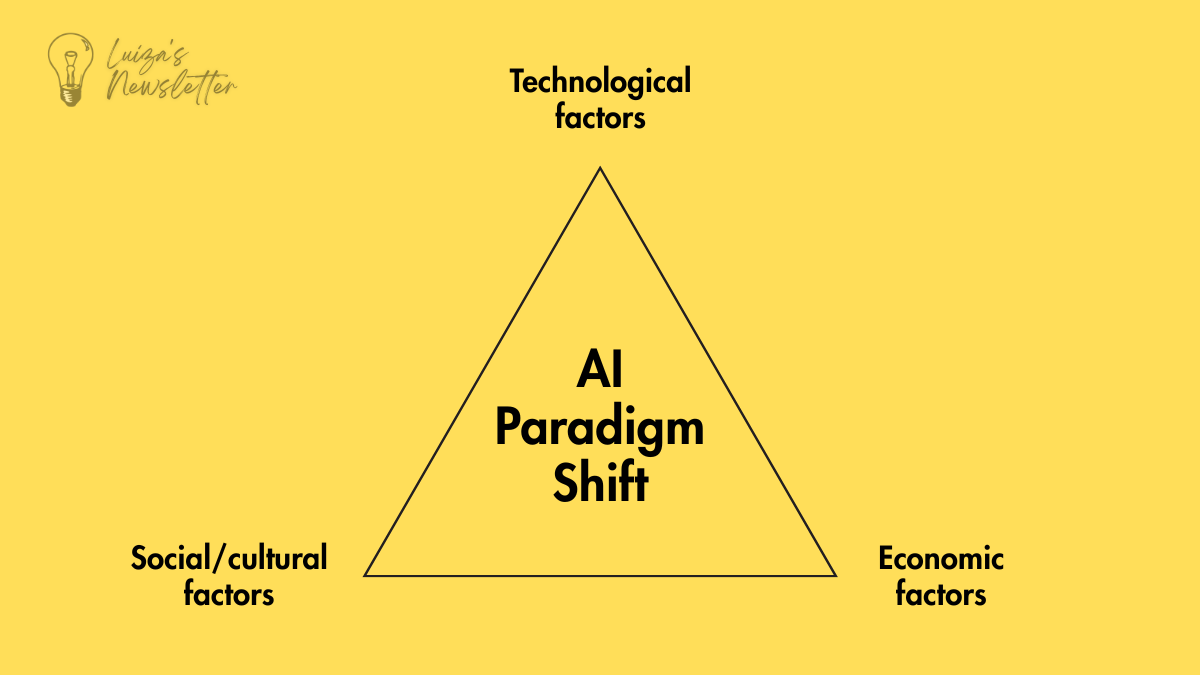
When analyzing the synergetic impact of these factors, the outcome has been significant, leading to changes in the way hundreds of millions of people live, work, create, and understand themselves:
1. Technological factors
From a technological perspective, LLMs and generative AI systems in general were largely unknown to most people back in November 2022.
There were no mainstream, freely available tools for creating extremely realistic images, audio, and video, or for creating coherent, human-sounding text on any topic and in any style.
Since then, LLMs have become mainstream and have been integrated into all sorts of B2C and B2B products.
Search engines and AI chatbots seem to be merging, agentic applications (for example, agentic shopping) are spreading, and AI feeds (such as Vibes and Sora 2) signal that the generative AI wave is becoming more ‘social’ and importing social media’s downsides as well.
You can read more about the second phase of the generative AI wave here.
2. Social and cultural factors
The social and cultural factors have been extremely important and perhaps the main driver of the paradigm shift.
The rise of generative AI has been meteoric. ChatGPT, the product leading the fever, reached 100 million active users in two months and became the fastest-growing consumer-facing app in history.
Because most products had a freely accessible version, hundreds of millions of people could experiment with them.