



Facebook recently launched a new feature that allows people to give it access to their camera roll so they can receive suggestions of photos and videos, including collages and edits, to post on social media.
The feature is opt-in, and it requires ongoing access to the camera roll so Meta’s AI can automatically make suggestions.
According to the official announcement:
“To get creative ideas for you, we’ll select media from your camera roll and upload it to our cloud on an ongoing basis, based on info like time, location, or themes.”
My first question was: will Meta use photos and videos from Facebook users’ camera rolls to train its AI?
In the announcement, Meta mentions that if the user chooses either to edit the photo or video with Meta’s AI tool or to share it, the photo or video will be used by Meta to train its AI.
Additionally, a screenshot from the consent pop-up screen shown in the announcement (below) says: “Media and facial features can be analyzed by Meta AI.”
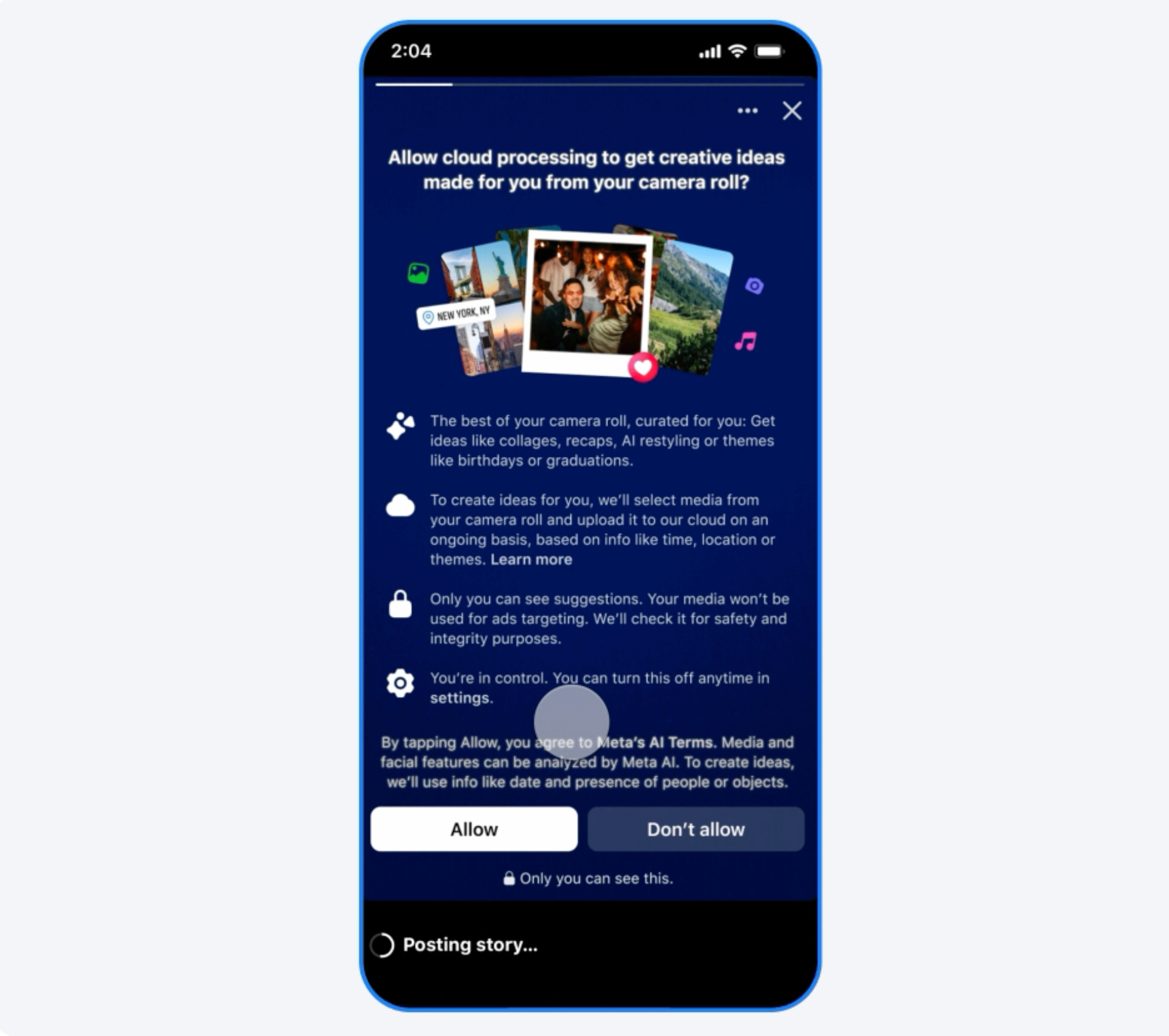
After reading the announcement, it was still unclear to me exactly how they were going to process camera roll media, including for AI training, so I checked Meta’s Privacy Policy.
Then things got much worse.
There, “camera roll content” is mentioned 13 times (!) in the context of data that can be collected from users and processed by Meta. It says that Meta can use camera roll content to:
Personalize Meta’s products
Improve Meta’s products
Promote safety, integrity, and security across Meta’s products
Communicate with users
Transfer, store, or process information across borders, including with partners, third parties, and service providers
Provide measurement, analytics, and business services
Share information across the Meta companies
Conduct business intelligence and analytics
Identify the user as a Meta product user and personalize ads (*the consent pop-up specifically mentions that camera roll content will not be used for ad targeting, so it is unclear how exactly it will affect advertising)
Research and innovate for social good
Anonymize information
Share information with others, including law enforcement, and respond to legal requests
Process information when required by law
Regarding the AI aspect specifically, since Meta’s AI will have to constantly analyze media from the camera roll to select which ones to suggest, I found both the announcement and the Privacy Policy to be ambiguous.
It is not clear to me whether Meta could argue that it might use camera roll content to “improve Meta’s AI” (see the second item above, as Meta AI is a product), but not to “train it,” regardless of the practical differences.
But here is what most people are not noticing: