

How AI Is Changing the Job Market in 2026
The latest data on AI-driven unemployment, AI exposure, how AI is reshaping work, and the jobs of the future | Edition #299


Ongoing technological changes make some jobs obsolete and others in demand. This is neither new nor surprising, as it has been continuously happening.
To use a few examples from the past hundred years:
Telephone operators were in high demand when the first telephone networks were established; today, they barely exist;
A percentage of bank tellers was replaced by ATMs during the 20th century, and many of those who remained have been replaced by remote app services in the past two decades;
Factory workers have been continuously replaced by industrial machines;
Agricultural workers have been continuously replaced by tractors and other agricultural equipment;
Video rental store employees were (almost) fully replaced by self-serving streaming services such as Netflix;
Travel agents are slowly being replaced by self-service platforms such as Booking, Airbnb, Skyscanner, TripAdvisor, and many others;
And the list goes on.
The reverse trend is also true, and technological innovation has continuously created new jobs and paved the way for the rise of new skills and occupations.
In the 20th century, we saw the emergence of hundreds of new professions that remain essential today, including:
car mechanics;
commercial pilots;
sound engineers;
film directors;
television producers;
software developers;
IT technicians;
video game designers;
and many others.
Looking at the past two decades alone, we have seen the emergence and growth of careers that would not have made any sense (and may even have seemed absurd) to someone born in the early 20th century. Examples include:
Instagram influencers;
YouTube creators;
social media managers;
SEO specialists;
mobile app developers;
and many others.
More recently, the past few years have led to the rise of occupations directly associated with AI development and deployment, such as:
LLM engineers;
RAG specialists;
AI agent architects;
red teamers;
AI artists;
AI governance professionals;
and many others.
The job market is not static; it constantly changes in response to economic, political, legal, social, and technological transformations in a given time and place.
Depending on the size and abruptness of these societal transformations, especially those driven by technological developments, which can occur at high speed and affect people systemically and globally, their impact on the job market can be particularly intense and poorly absorbed.
Poor absorption could, in practice, mean that more jobs have become obsolete than new ones have been created, or that most people lack the necessary training or skills to perform those high-demand jobs.
In that scenario, a growing number of people will be at risk of becoming unemployed, losing income, or having fewer professional opportunities.
We are now more than three and a half years into the generative AI wave, and much has been said about how AI might lead to a “jobpocalypse.”
I reviewed recent 2026 reports on the impact AI has had on the job market, and this is what I found:
1. AI-driven unemployment
So far, there seems to be no evidence of massive AI-driven unemployment.
According to this Yale report from three days ago, there is no clear evidence yet of labor market disruption that is directly associated with AI. It states:
“Churn across occupations, AI exposure among the unemployed, and comparisons of AI-exposed and unexposed workers all remain flat, lie within historical ranges, or continue along pre-AI trends.”
At the same time, there has been a sharp rise in the use of AI as the primary justification for job cuts.
According to the Challenger, Gray & Christmas report, in May 2026, AI was the leading reason for job cuts in the U.S. for the third consecutive month. AI alone accounted for 40% of all cuts announced in May:
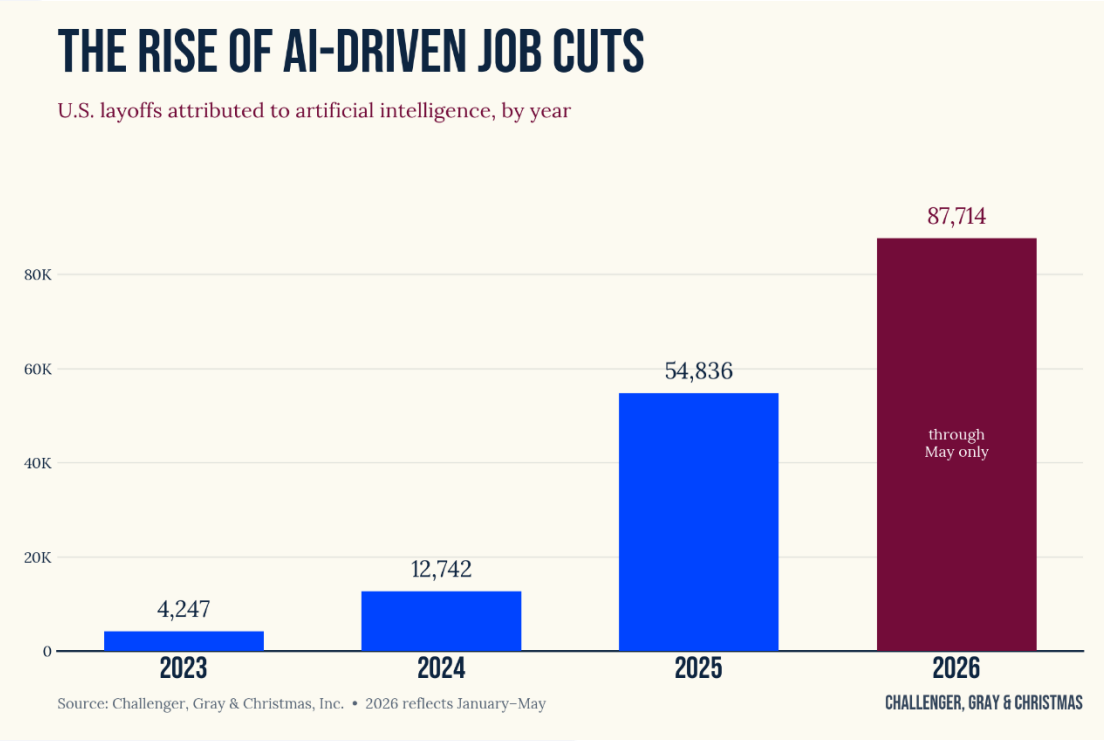
The report clarifies that even though AI might not be fully replacing workers’ tasks today, firms are acting on the possibility of a productivity increase:
“AI isn't yet the jobpocalypse some predicted. Like spreadsheets and email before it, the technology will ultimately make workers more productive, but our data shows companies are already acting on it, citing AI for more cuts than any other reason.”
Here, it is important to remember that even though companies are using AI as an excuse to fire people, that does not necessarily mean AI has made these jobs obsolete. Layoffs often reflect political, cultural, and managerial shifts that may or may not be related to AI.
Many companies want to position themselves as “AI-first,” and part of that ethos is a more aggressive stance on AI productivity, often requiring workers to periodically report how they use AI and evidence of productivity gains. Companies might lay off employees who do not achieve specific AI targets or do so with the goal of achieving a ‘leaner,’ “AI-first” workforce.
Companies could also be citing AI as an easy excuse to lay off people to cover excessive hiring or decreased revenue, for example.
2. Negative impact on junior workers
At the same time, there appears to be evidence of fewer professional opportunities or more pressure on junior workers.
A PwC report from three days ago highlighted that the traditional career ladder is “compressing,” and AI-exposed junior roles are seven times more likely to demand traditionally senior skills such as leadership and strategic thinking (compared with the least-exposed junior roles).
The report adds that companies must rethink how they train junior staff and “help them step up to complex decision-making much earlier in their careers.”
The reality is that someone entering the job market will not have had the chance to meaningfully practice leadership skills, and if this person’s tasks are highly automatable or AI-exposed, the employer is unlikely to invest in further training.
The expected consequence is that a more senior professional will end up absorbing this “seniorized” entry-level role, or the company will hire a senior professional into an entry-level role.
An IMF report from January 2026 confirmed that junior workers are more exposed to AI than senior workers, and added that:
“There is emerging evidence for the United States that generative-AI adoption has been reducing entry-level hiring - especially where tasks are automatable rather than complementary to humans.”
Another November 2025 paper written by Stanford researchers found that:
“Early-career workers (ages 22-25) in AI-exposed occupations experienced 16% relative employment declines, controlling for firm-level shocks, while employment for experienced workers remained stable.”
Today, young people’s reality is that they must navigate the usual job market challenges amid the uncertainty posed by the high level of AI exposure in entry-level tasks.
3. AI is reshaping work
Regarding the broader workforce, the availability of advanced AI models has directly affected how millions of people work and the expectations around work and productivity.
If many employees can get more work done with the help of AI, that will directly affect what employers and managers expect from work in general, across all employees.
What is acceptable, expected, and desired today differs from what it was a few years ago, which highlights the importance of strong AI literacy, especially in avoiding AI divides.
A BCG report from April 2026, for example, estimates that over the next two to three years, 50% to 55% of jobs in the United States will be reshaped by AI.
In practice, for many employees, this might mean that they remain in the same role but face new expectations for how they work and the type of work they produce.
The report also points out that cognitive load, in general, will intensify:
“Many roles currently balance structured execution with higher-level thinking. As repetitive tasks are automated, the remaining work will be concentrated in problem-solving, decision-making, and the integration of complex inputs, increasing the cognitive intensity of work. While some workers will thrive in more judgment-driven roles, others may struggle with the shift toward continuous high-level cognitive engagement and will require upskilling.”
On the consequences of increased cognitive load, a Harvard Business Review report from January 2026 reframed the idea of AI productivity and stated that AI does not reduce work, but intensifies it, possibly leading to cognitive fatigue, burnout, and weakened decision-making:
“AI adoption can be unsustainable, causing problems down the line. Once the excitement of experimenting fades, workers can find that their workload has quietly grown and feel stretched from juggling everything that’s suddenly on their plate. That workload creep can in turn lead to cognitive fatigue, burnout, and weakened decision-making. The productivity surge enjoyed at the beginning can give way to lower quality work, turnover, and other problems.”
AI will directly reshape the work exposed to current and foreseeable AI capabilities, so to understand how different occupations are impacted, we must investigate both theoretical and observed AI exposure.
4. AI exposure trends
This Anthropic report from March 2026 highlighted the level of theoretical capability and observed usage by occupational category:
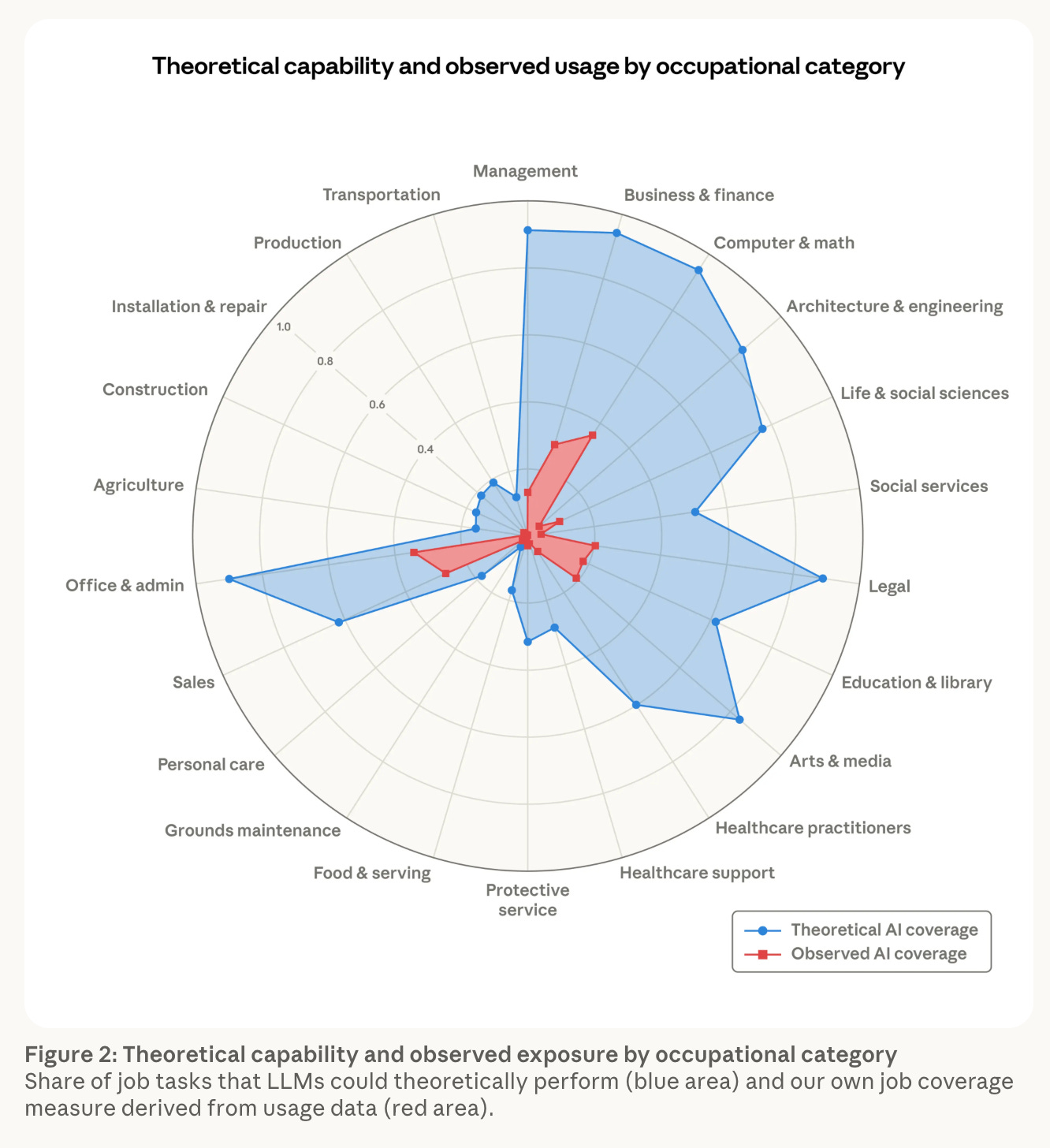
The figure above shows that there is scope for LLM penetration in the majority of tasks in computer & math (94%) and office & admin (90%) occupations.
At the same time, if you focus on the red area of the figure, it shows that AI is still far from reaching the full potential of its theoretical capabilities. I will add that due to economic, political, social, cultural, and legal factors, it might never do so.
Anthropic’s report also lists the ten most exposed occupations, with computer programming (74.5%) and customer service (70.1%) at the top:
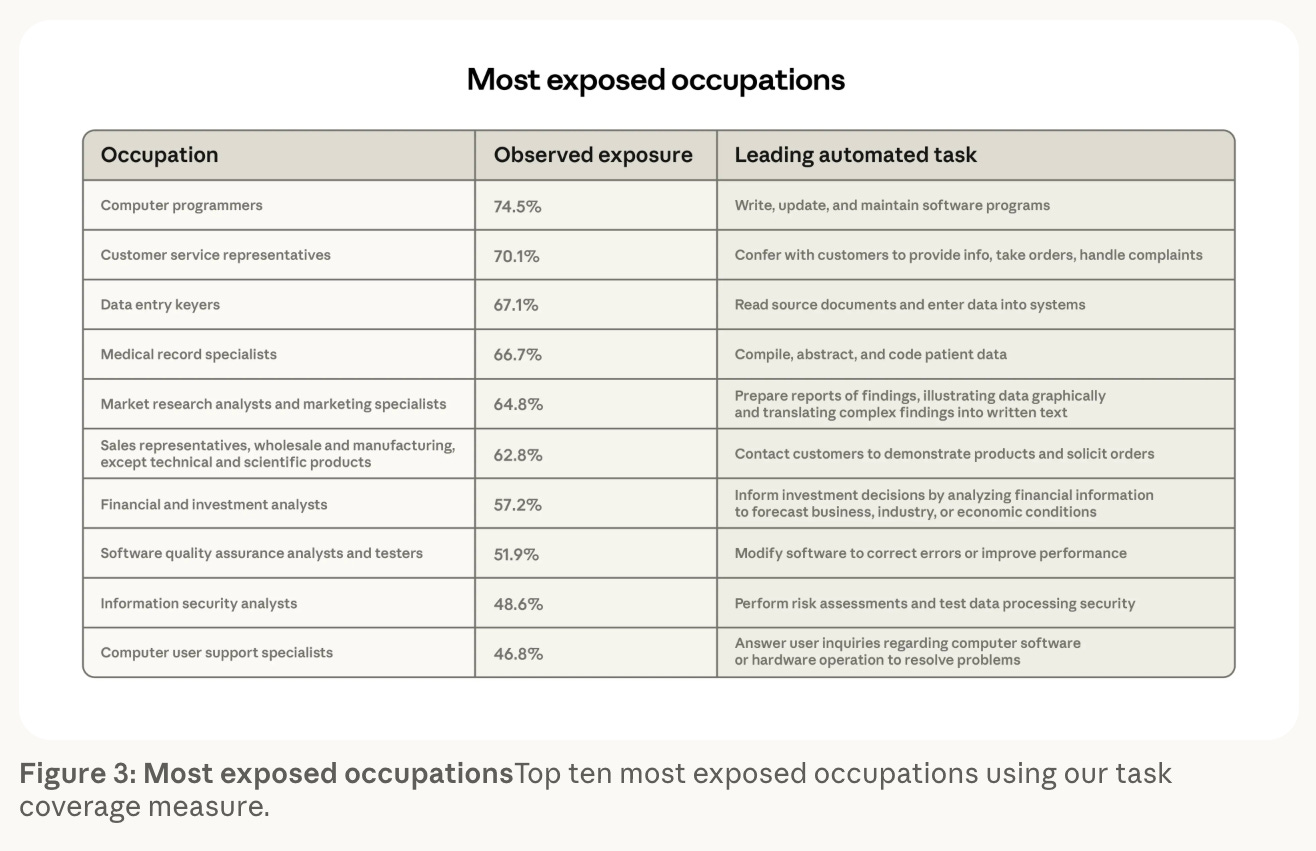
Anthropic states that 30% of workers have no LLM coverage today, including cooks, motorcycle mechanics, lifeguards, bartenders, dishwashers, and dressing room attendants.
Because generative AI broadly automates cognitive tasks, every white-collar worker and service company should continually monitor the market for technological changes, as emerging AI capabilities could, in a short period of time, put their occupation or service at risk.
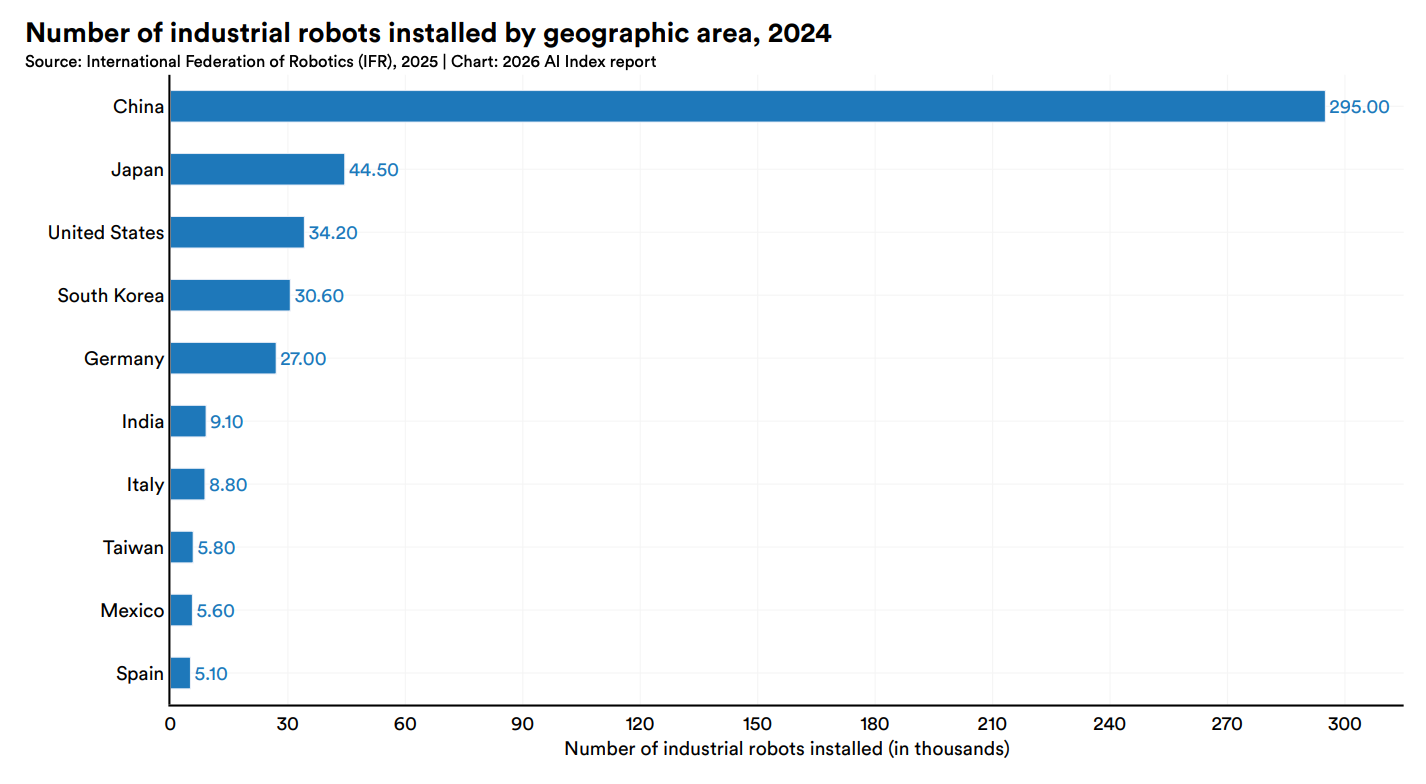
Blue-collar workers, on the other hand, seem to be safer, at least for now, and at least until robots and various forms of embodied AI take off in Western countries.
In China, the reality is different, as the Stanford HAI 2026 report shows:
5. People are preparing for major job market shifts
As with previous technological disruptions, those whose professional training is more closely aligned with in-demand careers, which today seem to be those not exposed to AI or directly associated with AI development and deployment, will more likely be able to secure career growth opportunities.
Those whose job tasks are fully or partially covered by existing AI models’ capabilities and who have not upskilled to navigate AI-related challenges and demands will likely be at greater risk.
Many people have already realized that and are taking action. My anecdotal data from the 30 global cohorts of my training program over the past three years confirms this.
I have met numerous people, including senior engineers, lawyers, designers, product managers, translators, entrepreneurs, artists, and other professionals from a wide range of fields, such as privacy, cybersecurity, and technology, who saw their careers at risk and chose to proactively upskill and seek roles more closely aligned with AI.
I also met many who have already lost their jobs, regardless of whether AI was used as an excuse to fire them, and who decided that the safest choice today was to invest in training that would allow them to work more closely with AI development and deployment, as these seem to be the careers offering better job security right now.
6. The jobs of the future
A big question with practical implications for everyone trying to make a living and thrive in an AI-driven world is:
Which jobs are in high demand, and how should I invest my time and money today to ensure that I will not be rendered obsolete in the coming months or years?
My first answer to that is that nobody knows what will happen in AI (and beyond) over the next 5, 10, or 20 years.
What we can do is observe broader economic, social, political, legal, and cultural trends and identify relevant patterns to help us make wise professional decisions and adapt accordingly.
Looking at China as a case study, a country that in some applied AI fields seems to be at least five years ahead of Western countries, can give us a sense of which skills and occupations are likely to be in high demand in the years ahead.
Between the years 2021 and 2025, China’s universities have suspended over 12,000 undergraduate programs and introduced over 10,000 new ones.
In practice, it means that more than 30% of the country's undergraduate programs underwent adjustments to better serve national needs amid profound technological, economic, and social transformations.
If you have been reading my articles, you know that China is probably the world's most ambitious country on AI.
China’s AI+ implementation plan, which refers to AI agents and sets specific targets for 2027, 2030, and 2035, states that:
“By 2027, China will have achieved extensive and deep integration of AI with six key areas, with the application penetration rate of next-generation smart terminals and intelligent agents exceeding 70%. The core industries of the intelligent economy will experience rapid growth, the role of AI in public governance will be significantly enhanced, and the open cooperation system for AI will be continuously improved.
By 2030, AI will fully empower high-quality development in the country, with the application penetration rate of next-generation smart terminals and intelligent agents exceeding 90%. The intelligent economy will become an important growth engine for the country’s economic development, promoting the inclusiveness of technology and the sharing of its benefits.
By 2035, the country will have fully entered a new stage of intelligent economic and intelligent society development, providing strong support for the basic realization of socialist modernization.”
That level of radical societal transformation is only possible at this accelerated pace due to the country’s political centralization, and I do not think it is realistic to think that a politically decentralized, democratic country would be able to achieve similar goals.
China's political centralization also affects the education system, facilitating efforts to promote careers aligned with national goals and disincentivizing those that do not seem aligned with the national strategy.
The transformation of the education system will likely happen in Western democracies as well, but it will take much more time and will not necessarily follow a government-led plan or vision.
In any case, looking at the careers considered “obsolete” and those considered essential offers an interesting glimpse into the future of work, especially in a country where exposure to AI is affecting both white-collar and blue-collar workers and whose AI strategy is probably the world's most ambitious one today.
Among the discontinued undergraduate programs, recent Chinese news articles cite:
information systems;
information and computing science;
public affairs management;
apparel and fashion design;
product design;
photography;
comics;
visual communication design;
new media art.
Among the new undergraduate programs being added are:
future robotics and interdisciplinary engineering;
embodied intelligence;
brain-computer science and technology;
energy science;
deep earth science;
engineering;
transportation energy;
integration engineering;
agricultural robotics;
biomanufacturing;
digital cultural tourism and commercial AI;
digital trade and digital finance.
According to Chinese news articles, some of the discontinued degrees were merged into more technology-focused degrees, so the skills taught were not entirely discontinued but were updated.
If you look at the degrees being added, they are clearly focused on applied AI development and deployment in a highly targeted, specialized way.
There is a clear economic reason for that. As I wrote in my article about China's new agentic AI framework, China takes an “application-driven development” approach to AI that focuses on building AI expertise and applied AI leadership in a broad set of areas, including energy, transportation, agriculture, tourism, and various other industries.
The newly added undergraduate programs focus on areas with expected high levels of AI penetration, according to the country's national plan.
We might never find the level of overarching AI disruption it is seeking, especially in its industrial sector, in other countries.
Also, as I wrote above (and the data from Stanford HAI's recent report shows), China is far more advanced than all other countries combined in industrial robotics, and it might still take many years for Western democracies to catch up and begin mass automation of blue-collar work.
However, China is a core player in the AI race, and America’s AI Action Plan and some of its current AI policies are heavily focused on establishing a technical edge in AI that surpasses China’s and also on preventing China from gaining access to the industrial inputs it needs to grow in AI.
The United States and other countries seeking to “win” the AI race will have to, at least in part, match China’s broad-spectrum capabilities and industrial edge in AI, and that might also involve investing in applied AI specializations, as China is doing.
For those looking for what is next in their career, or what field of study to recommend to a teenager focused on avoiding economic risk and obsolescence, the list above may offer a good hint.
Thanks for this review of recent research. I did my own review at the end of last year and came away with very similar conclusions, i.e., no evidence of widespread job losses but still bad news for college grads and people in highly ai-exposed occupations. As for China, I’m glad you put “win” in quotes. After all, what exactly does that mean? Does “winning” mean we have to treat workers so poorly that we too have to install suicide nets outside our factories?
Doesn’t China have more industrial robots because we already outsourced industrial production to China? Plus, China is massive