



Thinking Machines Lab, the company founded by former OpenAI CTO Mira Murati, recently announced a research preview of an interaction AI model it calls “a scalable approach to human-AI collaboration.”
This is an interesting AI model that proposes a paradigm shift in how humans and LLMs interact, both conceptually and architecturally, especially because it incorporates ‘human-like’ interactions natively as a core feature.
It is still a preview, but when it becomes available to the public, it will likely be disruptive (and create new risks as well). I do not think the media has given this release the attention it deserves.
Before I comment on the model's capabilities and some of its AI governance implications, let's take a look at Thinking Machines itself.
The company was launched by Murati in February 2025. In October, it released its first product, Tinker, a flexible API for researchers, developers, and companies to fine-tune and customize AI systems.
Many have praised Tinker as a solution to the AI integration bottleneck, as it allows companies to better customize AI models for their needs. One month later, the company was looking for a $50 billion valuation.
Thinking Machines positions itself as an AI research and product company focused on improving AI customization and adaptability, including through enhanced human-AI interaction.
A few days ago, the company launched its second product: a research preview of an interaction AI model.
The preview treats human-AI interaction as a core feature (without the need for external wrapper systems), and uses a multimodal, time-aware, micro-turn design to make human-AI interaction seem more human-like.
In AI models such as GPT, Claude, and Gemini (and most mainstream LLMs available today), human-AI interactions work in a “turn-based” way: the model first waits for the user to finish their input, then generates its output; next, the user must wait for the model to finish generating its output before prompting it again.
Thinking Machines' new interaction model adopts a “multi-stream, micro-turn design” instead:
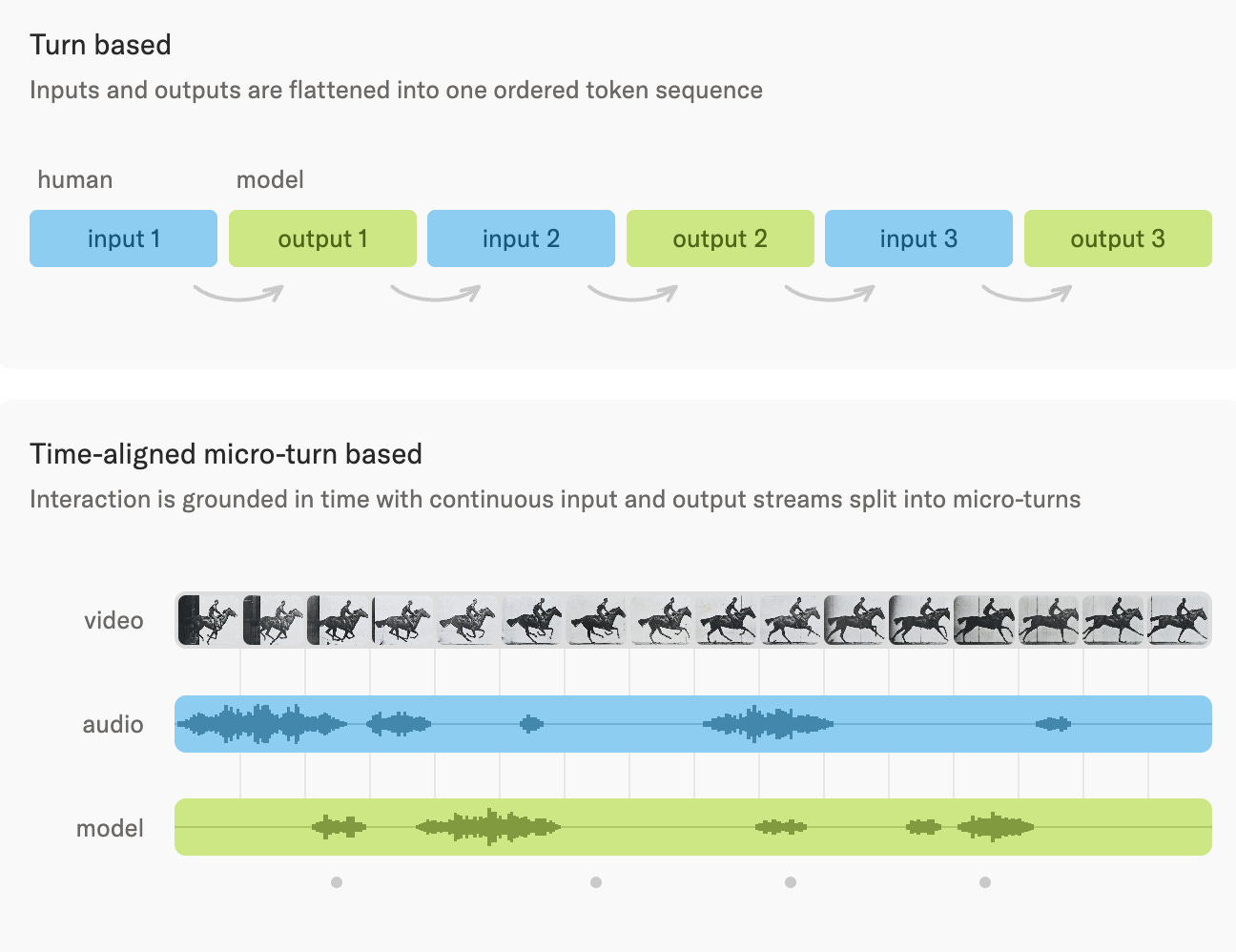
This means that both the user and the AI system can message, talk, listen, see, show, and interject continuously, even if the user has not technically finished the previous input or the AI has not yet finished the previous task.
Their two-minute demo helps clarify how this approach works in practice:
A core thesis behind this new interaction AI model is that AI models and AI interfaces must be natively optimized for humans to ‘remain in the loop’ and keep providing feedback while the model executes the task.
This way, according to the company, interactivity scales with intelligence, and human-AI interactions will be increasingly enhanced.
These are the AI model's capabilities, as listed by Thinking Machines. I highly encourage you to watch the other short demos (here), which show how each of these capabilities works in practice:
Seamless dialog management: “The model tracks implicitly whether the speaker is thinking, yielding, self-correcting, or inviting a response. There is no separate dialog management component.”
Verbal and visual interjections: “The model jumps in as needed depending on the context, not only when the user finishes speaking.”
Simultaneous speech: “The user and the model can speak concurrently (e.g., live translation).”
Time-awareness: “The model has a direct sense of elapsed time.”
Simultaneous tools calls, search, and generative UI: “While speaking and listening to the user, the model can concurrently search, browse the web, or generate UI - weaving back results into the conversation as needed.”
Thinking Machines' architecture and design choices in this preview are truly innovative, and when the model is made public, it will directly affect how people experience human-AI interaction.
This is impressive. However, it will also introduce new layers of risk.
If AI systems become capable of interacting with humans in a more continuous and human-like way, existing safety and governance frameworks may quickly become insufficient to protect people from harm.
From an AI governance perspective, this new interaction paradigm raises concerns that anyone working with AI systems will need to start taking seriously: