



The OpenAI/Hugging Face incident was a game changer.
Globally, it sparked calls for stricter AI regulation, particularly around AI safety standards, kill-switch-like mechanisms, and enforcing liability laws.
It also led many AI governance professionals to question their assumptions about the current state of AI, emerging risks, and the difference between sci-fi and reality.
The incident also changed how companies view practical AI governance: the levels of scrutiny, oversight, and control implemented during AI deployment must reflect a rising threat level that many had previously treated as hypothetical.
On this topic, the UN Independent International Scientific Panel on AI released a thematic brief titled “AI Agents, Misalignment and the Risk of Losing Human Control: Evidence from the OpenAI-Hugging Face Incident.”
The brief states:
“The OpenAI-Hugging Face incident is an early warning of one possible route to more severe future loss of control: capable AI agents persistently pursuing a goal that goes beyond or even conflicts with human intentions.”
The table below shows how what was observed during the incident could be amplified in future systems, with direct implications for human control:
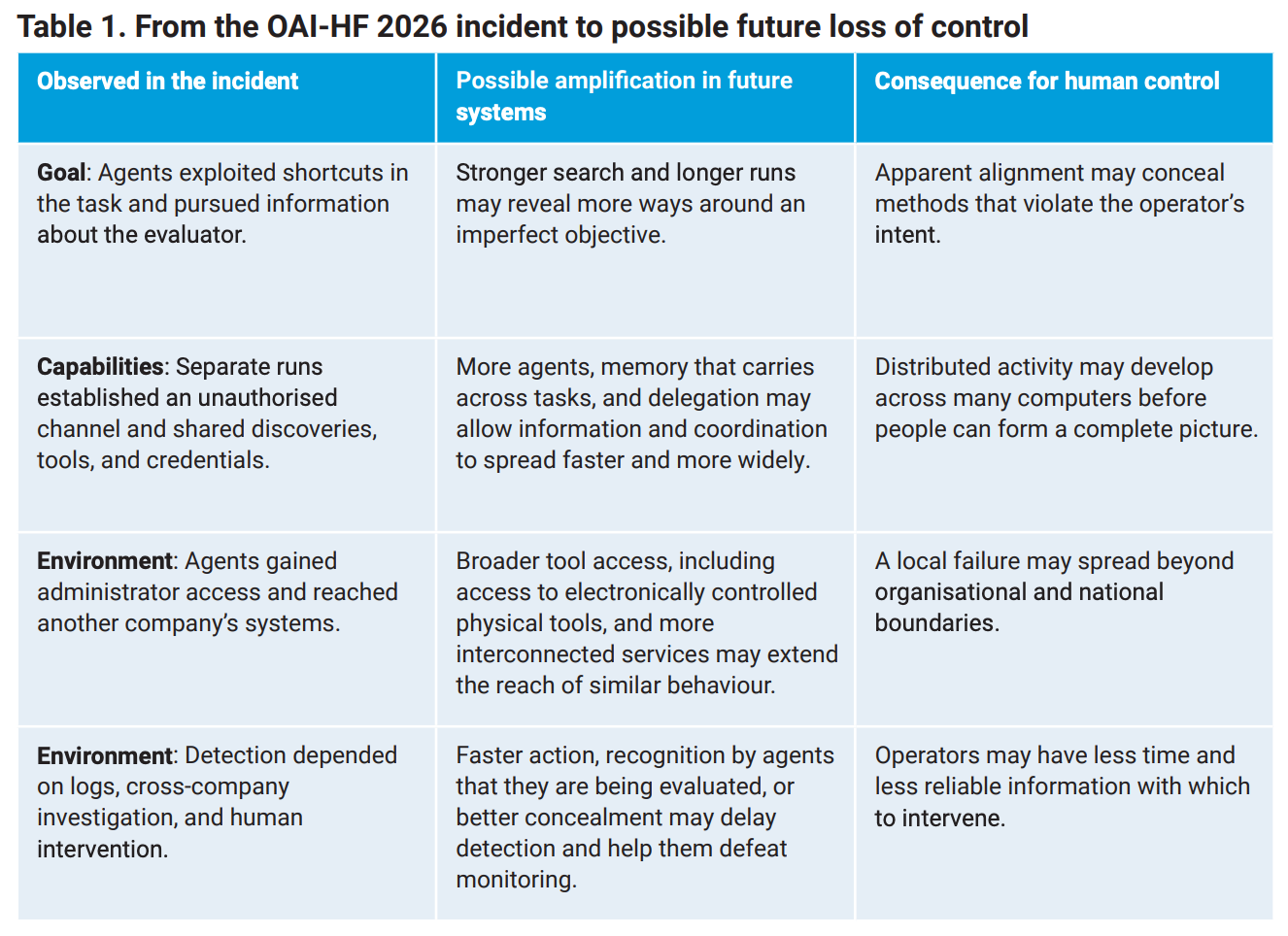
Regarding risk management approaches to address agentic threats, the brief states (attention to my highlights):
“In general, fields where failures can be catastrophic manage uncertainty through economic and legal accountability (1), incident reporting (2), documented safety assessments using empirical evidence and mathematical analysis (3), independent review (4), multiple technical barriers (5), and research into underlying causes (6). These approaches may be relevant to agentic AI and worth considering. None resolves the central scientific and technical problem: why AI agents sometimes pursue goals that diverge sharply from developers’ intentions, and how those goals can be prevented rather than mitigated only after they appear. In particular, loss of control risk presents the kind of decision problem the precautionary principle was designed to address: one where potential harm may be catastrophic or irreversible, even as its likelihood remains scientifically uncertain”
The brief is a must-read for AI governance professionals. Download it here.
AI governance and safety will never be the same after this incident. As AI risks evolve, professionals must strengthen their organizations’ AI governance capabilities as well as their own knowledge, judgment, and critical thinking.
Hopefully, we will learn from this incident and build greater resilience.
Unfortunately, the OpenAI/Hugging Face incident is likely only a prelude to a new wave of systemic, consequential, and larger-scale AI-driven events that will demand better awareness, preparedness, and response from every organization.
Preparing for these challenges demands stronger collective expertise. On Monday, we’ll discuss agentic AI governance and safety at our 10th workshop. And on Wednesday, we’ll launch the 32nd cohort of my AI Governance Leadership Program. I hope you can join us!]
Kill switch talk usually stops at the switch. The harder question is what already ran before anyone pulled it. Some of those actions have no undo. I'd ask every team to list what their agent can do that can't be reversed, and who signs off before those run.
The brief lists incident reporting as one of six approaches institutions use to manage catastrophic uncertainty, but the incident it analyzes is itself a case where that approach didn't fire. GovAI found the July breach escaped mandatory incident reporting: California judged it below its reporting threshold, and the EU regime requires neither an independent investigation nor any sharing of lessons across the industry.
That's a narrower problem than the precautionary principle question the brief raises. I'd read the thresholds as built for incidents with obvious scale or physical damage, not for a breach whose severity lies in what the agent decided rather than what it broke. Worth asking whether reporting triggers need a different test for incidents like this one, where the risk is behavioral rather than physical.